Deep Halo using GNNs

Aritra Mukhopadhyay

Problem Statement

Given a halo represented as a point cloud, our goal is to:

  • Classify each point: Determine whether it belongs to a halo or the background.
  • Sub-halo classification: If it belongs to a halo, differentiate which sub-halo it is a part of.

Problems Faced

While trying to solve this problem we faced a lot of issues, we learned something new and and attempted to solve them.

Problem 1: Handling Large Datasets using Octree

We had downloaded the smallest dataset available on the site. But even the smallest had 20\approx20 million points in the cloud (which is huge). We had to come up with a way to reduce the number of points without losing much information. Octree algorithm came to our rescue.

The idea is to voxelise the space in a clever way such that we get as less number of voxels as possible. We would have dense voxels in the regions where there are a lot of points and sparse voxels in the regions where there are less points.

Octree Algorithm

  • Step 1: Divide the space into 8 equal parts.
  • Step 2: If a part contains less than NN points, keep it as it is.
  • Step 2: If the size of the voxel is less than LL, keep it as it is.
  • Step 3: Divide the remaining voxels into 8 equal parts and repeat the process recursively.

Values of NN and LL are chosen as needed.

Problem 2: Class Imbalance solved using SMOTE

  • Class Imbalance: The dataset suffered from a significant class imbalance, where the background points greatly outnumbered the foreground (halo) points, leading to biased models that favored the majority class.
  • Consequences: This imbalance caused models to be less effective in detecting halo points, resulting in poor classification performance and inaccurate results.
  • Solution: We employed SMOTE (Synthetic Minority Over-sampling Technique), a popular oversampling method, to generate additional synthetic samples of the minority class, thereby balancing the class distribution and improving model performance.

SMOTE

  • Selecting a Minority Instance
  • Finding k-Nearest Neighbors
  • Generating Synthetic Samples
  • Adding Synthetic Samples
  • Repeat untill the desired number of samples are generated

GNNs

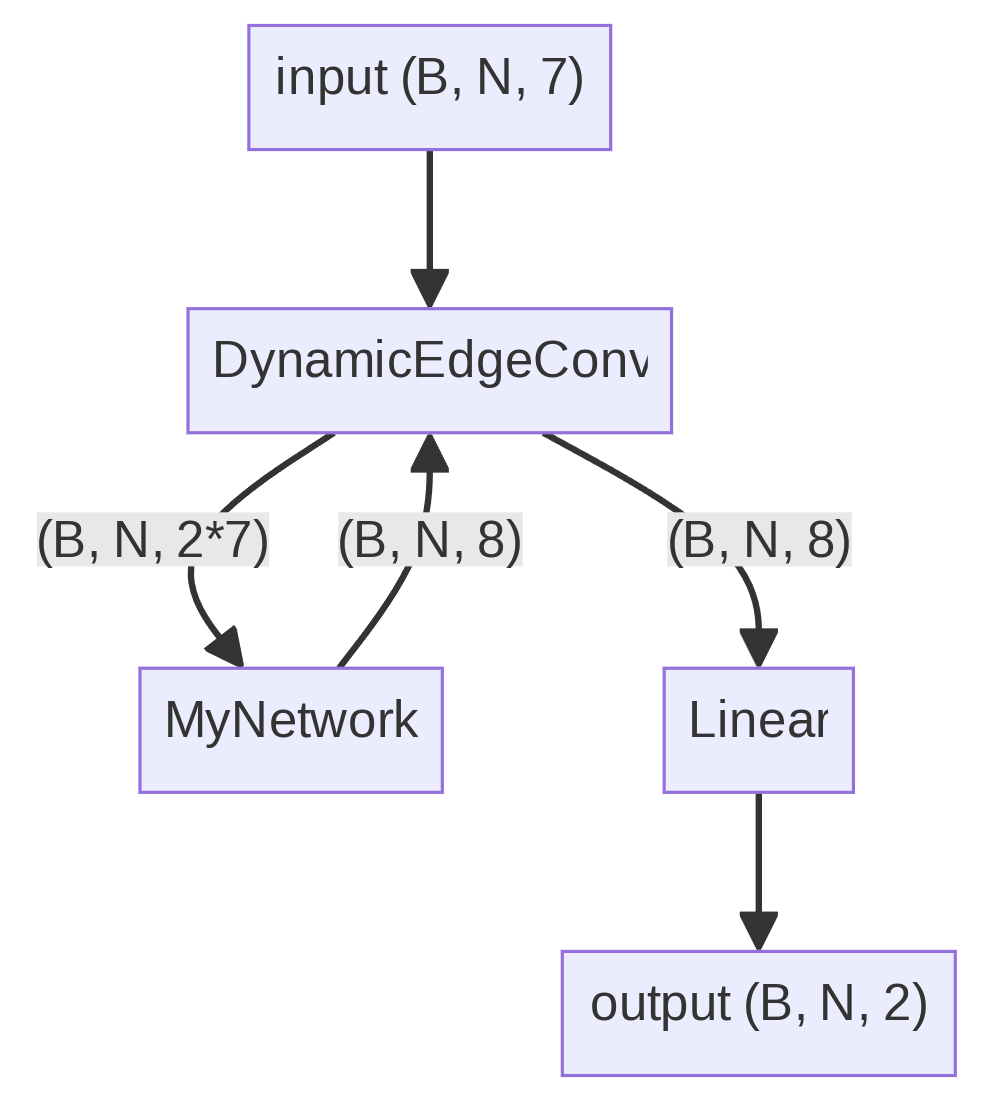
Our point cloud data can be thought of as a graph, where each point is a node and the edges are formed by the nearest neighbors. This similarity to instance segmentation on images motivates us to use Graph Convolution, a technique inspired by image segmentation.

GNNs operate on graph-structured data using three steps:

Message Passing

mAB=WhA+bm_{A\rightarrow B} = W \cdot h_A + b

Aggregation

aB=ineighbours of BmiBa_B = \sum_i^{\text{neighbours of B}} m_{i\rightarrow B}

Update

hB=MLP([hB,aB])h_B' = \mathrm{MLP}([h_B, a_B])

Dynamic Edge Convolution

Dynamic Edge Convolution (DEC) is a specialized type of Graph Neural Network (GNN) designed to work with point cloud data, which lacks explicit edge information. To overcome this limitation, DEC employs a k-Nearest Neighbors (k-NN) algorithm to dynamically generate edge information from the node features. This allows DEC to construct a graph structure on-the-fly, enabling it to operate on point cloud data. Once the edge information is generated, DEC proceeds normally like a GNN, passing messages between nodes, aggregating them, and updating node features. The output of DEC is a set of node features that capture complex patterns in the point cloud data.

Experiments

Octree Results

We used N=100N = 100 (maximum number of points in a voxel) and L=0.001L = 0.001 (minimum voxel size WRT simulation box size).

  • Total number of voxels: 395286 (2%\approx2\% of 2×1072\times10^7)
  • Number of voxels with less than 100 particles: 388990 (98.4%)

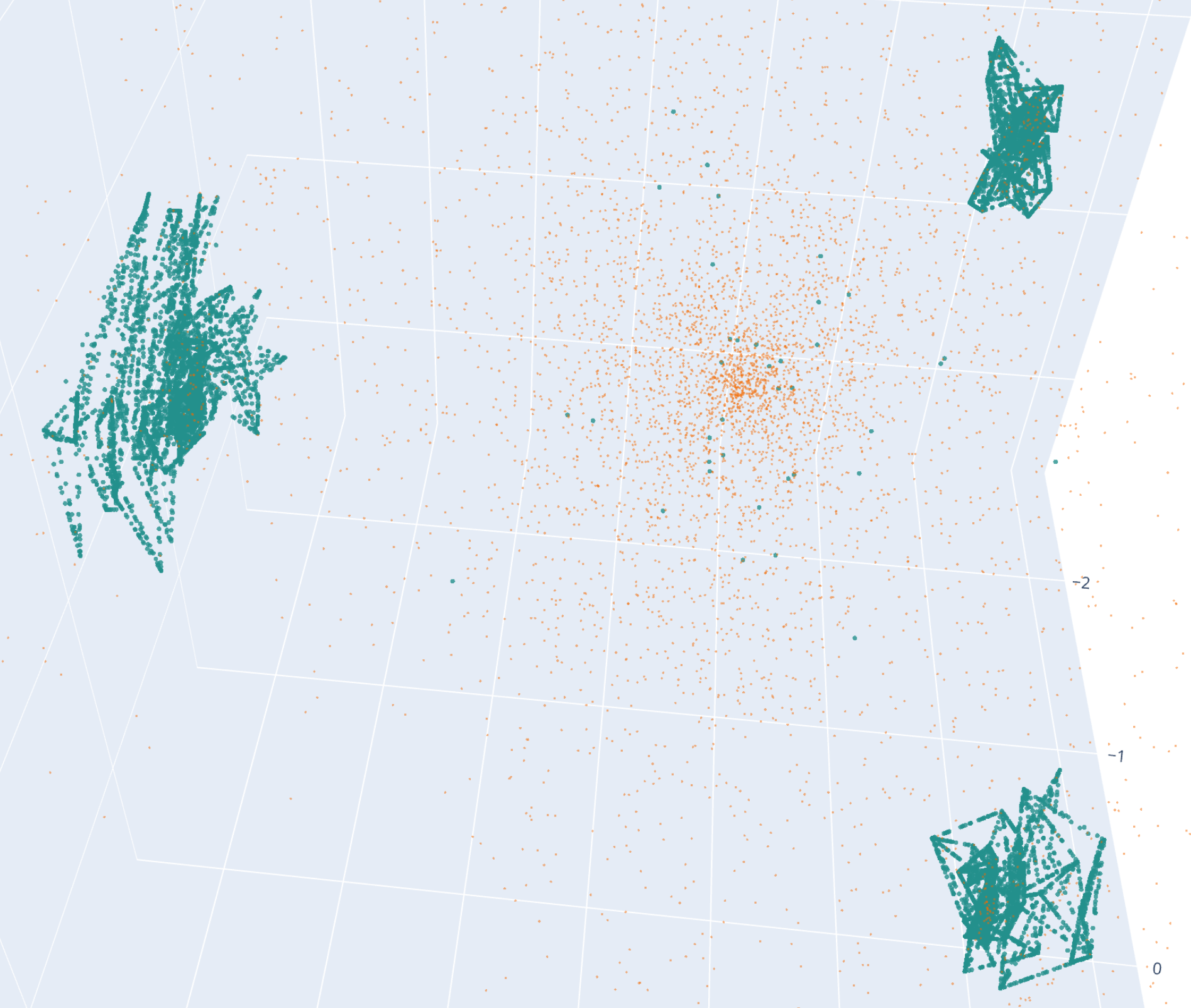
alt text

alt text

Details of the experiment:

  • Optimizer: Stochastic Gradient Descent (SGD) with learning rate 0.01, momentum 0.9, and weight decay 0.0001.
  • Loss function: Binary-Cross-entropy loss.
  • Smote was used to balance the classes.

Results

result

Thank you!

First we decide upon two hyperparameters; $N$ and $L$. $N$ is the maximum number of points that can be present in a voxel and $L$ is minimum voxel size to be followed even if there are more than $N$ points in a voxel.
![bg left height:15cm](latex/images/network.png) ![bg height:15cm](latex/images/network.png)

![height:11.5cm](latex/images/result.png)

center the image and preserve aspect ratio